mobile apps
Marcus works for a construction firm and for years, his approval process was problematic: those who needed to sign an order for materials were rarely at a desk. A Supervisor unable to be at the job site could not endorse a rebar order, causing a delivery to be delayed by 1 day, resulting in a schedule delay for a crew, which then led to an apologetic e-mail to the client. The materials existed. The budget existed. The only thing that was missing was the signature of someone who happened to be in a different place who didn’t have a laptop.
It’s this chasm between decisions and desks that’s why more procurement teams are turning to a mobile application development company rather than relying on the fact that approvals can only happen when people are at their desks. Procurement isn’t limited to an office anymore, and the organizations that are getting with this are the ones that’ve been eliminating the time-consuming pain in their pockets for years: The buyer waiting for a purchase order because the approver was not within a desktop reach.
The Desk Stopped Being Where Procurement Happens
Field teams, traveling managers, on-site engineers, and remote program leads all need to raise a purchase request, check a budget, or approve a spend decision from wherever they actually are, not from wherever a workstation happens to sit. When a key approver is away from a computer, requests stack up, spending drifts away from budget, and compliance checks that were supposed to happen before a purchase get skipped or backfilled later. Mobile procurement removes that dependency by putting the core procure-to-pay workflow, requests, approvals, budget checks, and receiving, directly on a phone. The shift isn’t really about convenience. It’s about removing a structural delay that has nothing to do with whether a purchase makes sense and everything to do with where a person happened to be standing.
Real-Time Spend Visibility Replaced the End-of-Month Surprise
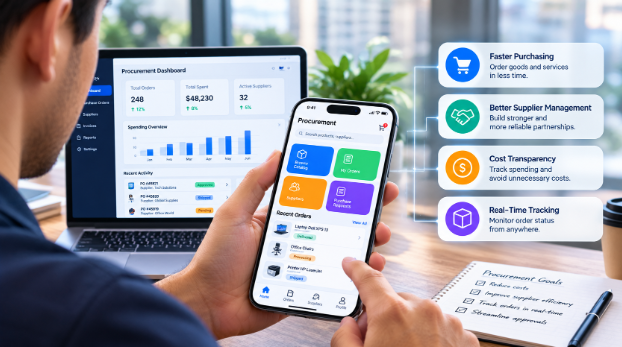
The procurement team were always informed when a budget was already used up, a few weeks before the report on the month’s expenses showed a department overspending its budget. Mobile dashboards that give real-time spend, committed dollars and budget remaining change that time. An approving manager from a phone will be able to see the true impact on the department’s budget in the same screen when approving the purchase request, and not on a separate downloadable report. That visibility can help fend off double buying, identify a supplier’s escalating price over the life of several small orders, and ensure compliance with the contract while no one was paying as closely as they needed to in real time.
Approval Workflows Got Smarter, Not Just Faster
The obvious benefit of a mobile approval flow is speed, but the more consequential shift is how much smarter the routing has become. Modern systems route a requisition automatically based on spend threshold, department, or risk level, and reroute it without anyone lifting a finger when the usual approver is unavailable. That single feature tends to be the first thing procurement teams evaluate when picking a platform, because a stuck approval is the most visible and most frustrating bottleneck in the entire purchasing process. A field supervisor like Marcus doesn’t need a complicated interface to approve an order. He needs the request to reach him wherever he is, with enough context to make the call in under a minute, and a system that knows to escalate automatically if he’s genuinely unreachable.
Supplier Management Moved Onto the Same Screen
Approvals are not the only part of procurement. But it’s not just the ongoing relationship of a business with its suppliers, and mobile has started to take that relationship into the same framework as all the other ones. A supplier portal enables vendors to submit their invoices, confirm delivery dates and respond to a purchase order without having to go through an additional email exchange or phone call, whilst the procurement team is able to monitor supplier performance and identify supplier risk directly from the same dashboard they use to approve purchases. What this actually implies is that the procedure is far more significant than appears on the surface and splitting up the interaction among suppliers and also the approvals in a different system is simply an ideal recipe for a communications void where information is lost and accountability is elusive.
Automation Took Over the Repetitive Middle of the Process
Procure-to-pay automation is quietly handling the parts of procurement that used to eat the most staff time without adding much value: matching an invoice against a purchase order, flagging a contract approaching renewal, routing a payment once goods are confirmed received. None of this requires a human to manually cross-reference documents the way procurement teams did for years, and the time saved compounds across an organization processing dozens or hundreds of purchase orders a week. The businesses seeing the strongest results tend to automate the middle of the process first, the matching, the routing, the reminders, while keeping a human firmly in charge of the actual purchasing decisions that require judgment rather than pattern matching.
AI Is Starting to Flag Problems Before They Become Budget Overruns
More than simply automation, AI-powered analytics are beginning to reveal patterns that the procurement team would have otherwise missed in time. A model based on past spending habits can identify a vendor’s up-trending pricing schedule and its potential for renegotiation, or even flag a spending trend that appears to be on a path to overrunning a budget long before it happens. This is not a replacement for procurement judgment, it is only a stepping stone to help your procurement team better identify the few purchase orders or supplier relationships that really need to be examined instead of waiting for a quarterly report to identify a problem.
Why Some Procurement App Rollouts Quietly Fail
Building the technology is rarely the hardest part of this shift, and it’s worth being honest about where these projects actually go wrong. Common reasons digital products fail in procurement specifically tend to cluster around a handful of predictable mistakes: a mobile app built as an afterthought to a desktop system rather than designed mobile-first from the start, an approval flow so complicated that field staff route around it and keep calling each other the old way, and integration gaps where the mobile app doesn’t actually sync with the ERP or accounting system it’s supposed to feed. A tool that looks impressive in a vendor demo but doesn’t fit how a specific team actually works gets abandoned within a few months, and the organization ends up back where it started, just with a more expensive version of the same manual workaround.
What Actually Makes a Procurement App Worth Adopting
Regardless of company size, the platforms have several characteristics that withstand daily use. They maintain a user-friendly interface that makes it easy for users with only weekly use to use without needing to retrain them, as not everyone who touches procurement does so as his/her sole occupation. They’re seamless to existing finance and ERP systems, since it’s of little use to have a mobile spending app that provides a second, separate record of spending when the existing one already exists. They provide that approver with enough information in one screen, without having to click on three other systems for their own peace of mind.
Offline Reliability Matters More Here Than in Most Business Apps
Approvals from procurement are often required in the areas with poor connectivity; they can be needed at a job site, a warehouse floor, a location in the rural areas, a server room in the basement. A mobile procurement app which is always connected breaks down during the time it’s needed the most. The tools developed for real field use record a request or an approval locally and store it in a queue if the connection is lost, automatically syncing it back the next time a signal is received, without losing the action or having to repeat it later. It’s that one design requirement which alters the underlying design in a significant way from a typical office productivity app – and typically it’s the detail that differentiates a procurement tool that field and site teams trust from one that gets quietly abandoned the first time it fails someone standing in the middle of a non-covered spot.
Security Has to Scale With How Much Trust the App Is Asking For
Including things like purchase authority, budget info, financial information on suppliers, and so on makes the procurement application much more of a security issue than an internal application would be. The role based access-control here is key because the same information shouldn’t be available to all users of the app: A field supervisor approving a routine materials order shouldn’t be able to see the enterprise-wide spend data, for instance, or a finance lead reviewing contract terms be able to see every individual field request across every site. As important as they can be said to be, audit trails are not a risk if the procurement is audited for compliance if no one can say, “Here’s what I’ve approved, here’s the time and here’s the budget conditions. These controls are not only cheaper to implement when a system is designed, but they are also cheaper to implement in an existing system because they are not added after a compliance audit reveals a need for such controls in an already operating system.
What Changed for Marcus’s Team
Marcus still gets purchase requests while he’s standing on a job site, but he no longer holds up a materials order because he’s forty miles from a desk. He sees the budget impact, the supplier’s delivery history, and the requisition itself on the same screen, and approves it in the time it takes to read it. The crews stopped losing a day waiting on a signature that had nothing to do with whether the order made sense. That’s the real shift running through procurement right now, not a flashier dashboard for its own sake, but decisions finally happening wherever the people making them actually are.